Difference Between DASS-21 and DASS-42 for Scoring, Reliability, and Use
The difference between DASS-21 and DASS-42 is mainly length, scoring workflow, and the level of detail each form gives. Both belong to the Depression Anxiety Stress Scales family and both look at depression, anxiety, and stress over a recent time period. The DASS-42 is the original longer form, with 42 total items. The DASS-21 is the shorter form, with 21 items and a faster path to the same three subscale areas. For many readers, an online DASS-21 screening tool is a practical first step for structured self-reflection, as long as the result is treated as educational information rather than a clinical assessment by itself.
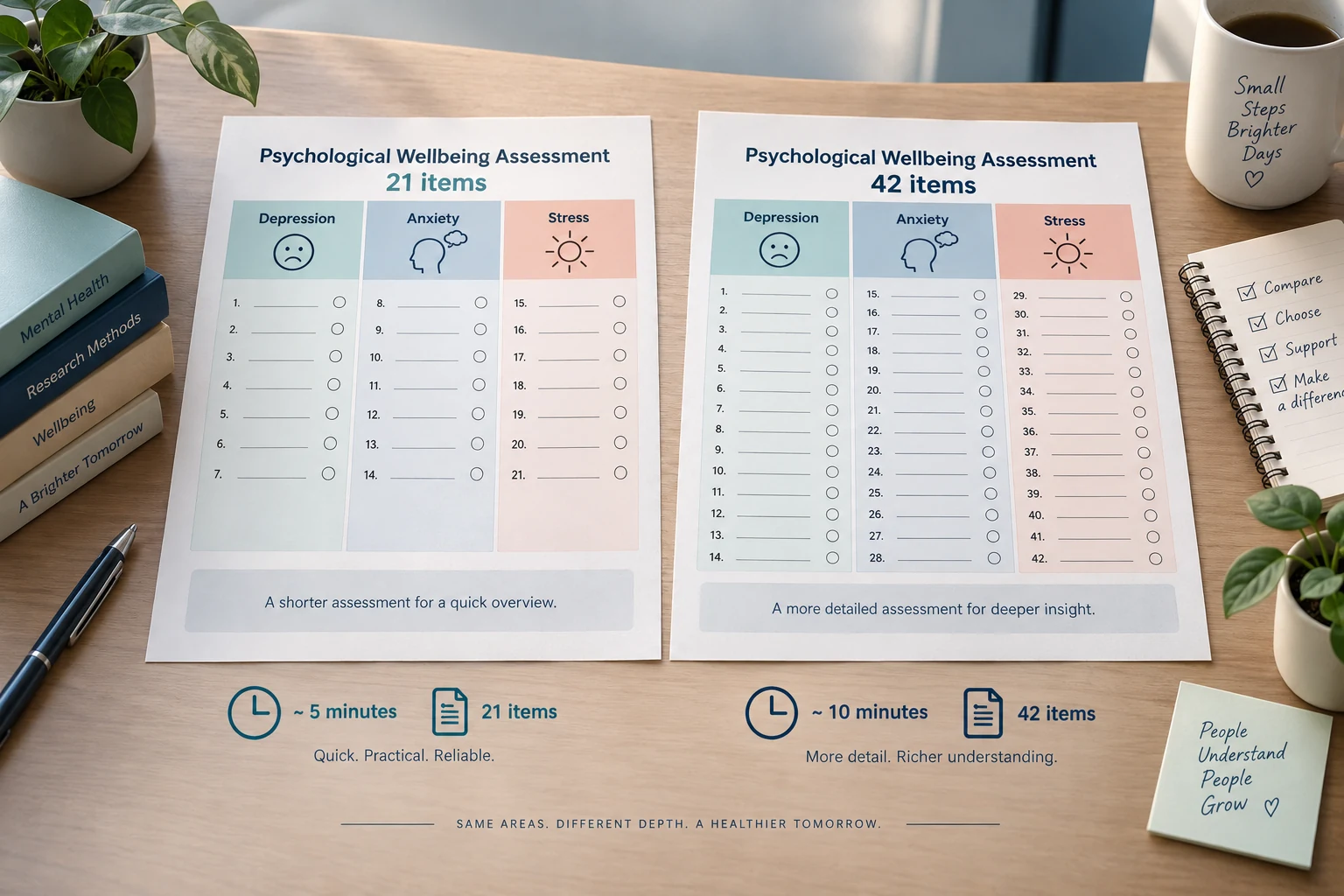
DASS-21 vs DASS-42 at a Glance
The quickest way to understand the comparison is to see the two forms as different lengths of the same measurement family. DASS-42 has 14 items for each subscale. DASS-21 has 7 items for each subscale. Both produce separate depression, anxiety, and stress scores, and both use response options that reflect how much each statement applied during the reference period.
| Feature | DASS-21 | DASS-42 |
|---|---|---|
| Total items | 21 | 42 |
| Items per subscale | 7 depression, 7 anxiety, 7 stress | 14 depression, 14 anxiety, 14 stress |
| Typical strength | Faster completion and easier repeated use | More item-level detail |
| Scoring note | Subscale totals are often doubled when compared with DASS-42 style severity ranges | Raw subscale totals already use the longer scale range |
| Best fit | Screening, education, quick self-checks, repeated reflection | Research, fuller assessment contexts, detailed monitoring |
This does not mean one form is automatically better for every person. It means each form answers a slightly different practical question. If the goal is to get a brief, structured snapshot, DASS-21 is usually easier to complete. If the goal is more detailed item coverage, DASS-42 may be preferred in research or professional settings.
How the Two Forms Are Structured
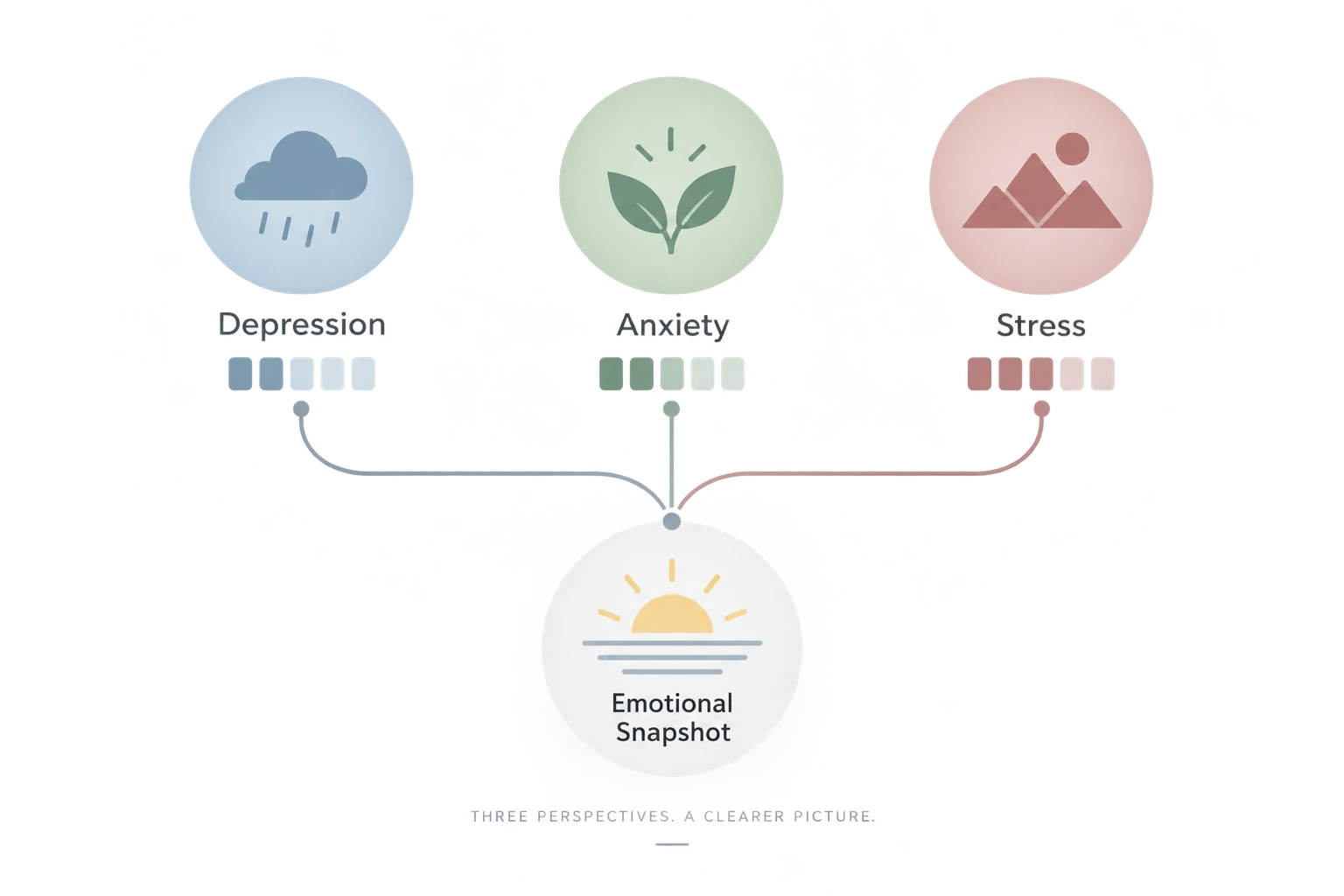
Both forms organize emotional symptoms into three subscales. The depression subscale focuses on experiences such as low positive emotion, hopelessness, and loss of interest. The anxiety subscale focuses more on anxious arousal, fear-related reactions, and physical tension linked to anxiety. The stress subscale captures tension, difficulty relaxing, irritability, and a sense of being overburdened.
The important structural difference is sampling depth. DASS-42 asks twice as many questions overall, so each subscale has more items representing the construct. DASS-21 keeps the same three-part framework but uses fewer items, which makes it more efficient. That is why a free DASS-21 self-check can be useful for people who want a simple starting point before deciding whether they need more context, professional support, or repeated tracking.
For content and search intent, this is also why people often look for terms like "dass-21 scoring and interpretation" or "dass-42 scoring." They are not only asking how to add numbers. They are trying to understand whether two forms can be compared and whether a shorter result carries the same meaning as a longer result.
DASS-21 Scoring and Interpretation
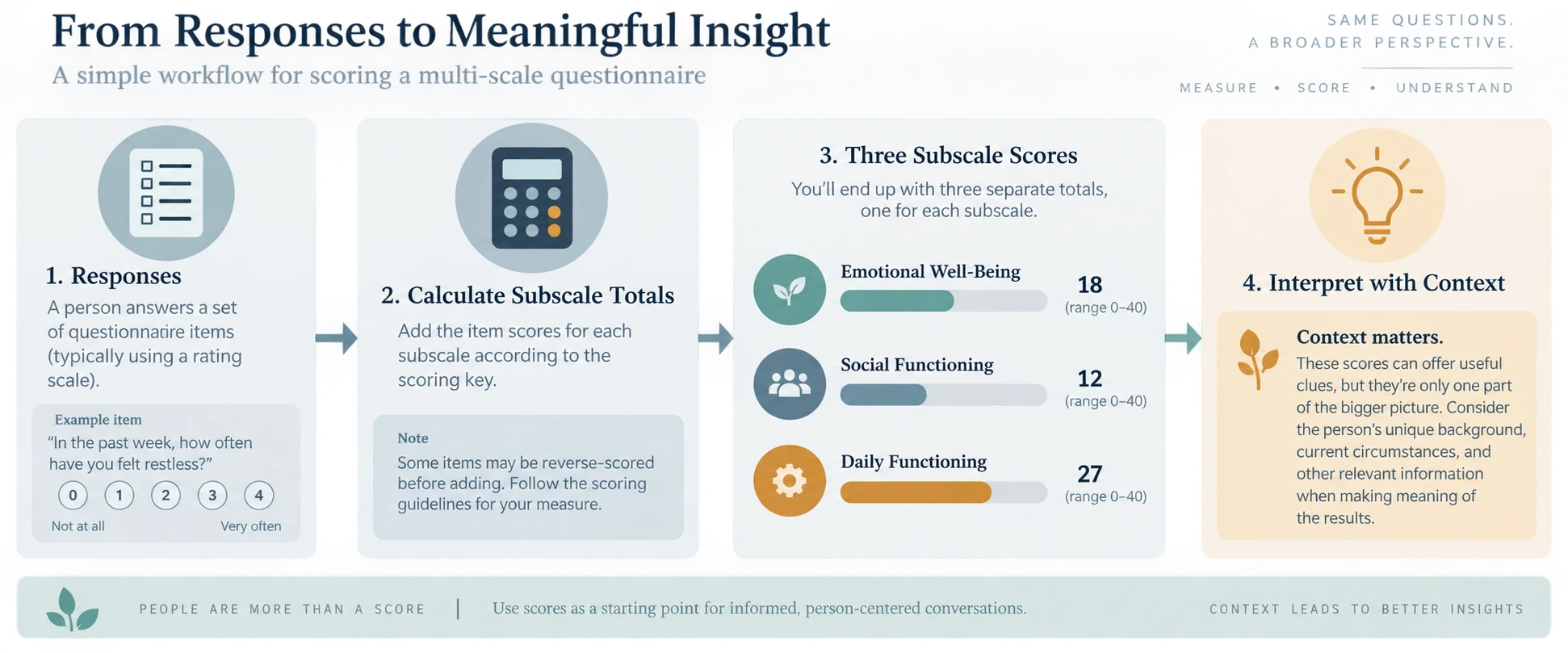
DASS-21 scoring starts by adding the seven items in each subscale. This gives a raw depression score, raw anxiety score, and raw stress score. Because the form has half as many items as DASS-42, many scoring systems multiply each DASS-21 subscale score by 2 when aligning it with DASS-42-style severity ranges from the manual tradition.
That multiplication step is a common source of confusion. A person may see one resource report the raw DASS-21 subscale score and another report the doubled score used for interpretation. Neither is automatically wrong, but the format must be clear. A raw DASS-21 depression subscale score out of 21 is not the same display format as a DASS-42 depression subscale score out of 42. When reading any result, check whether the score has been doubled, which severity labels are being used, and whether the tool explains its scoring method.
Interpretation should stay modest. A score can suggest that recent symptoms deserve attention, but it does not explain the full cause, context, duration, or risk level. It should be read alongside daily functioning, recent stressors, sleep, health conditions, medication effects, substance use, and support systems. If a score feels worrying or the person is struggling to function, professional guidance is the right next layer.
DASS-42 Scoring and Psychometric Properties
DASS-42 scoring also produces three subscale scores, but each subscale contains 14 items. The maximum for each subscale is therefore higher, and the total score can be shown across a broader range. This longer format can be helpful when a researcher or professional wants more item coverage for each domain.
Searches for "dass-42 psychometric properties" and "dass-42 reliability and validity" usually reflect a more technical intent. The longer form has a substantial research history, including work connected with Lovibond & Lovibond, 1995, and later studies that examine internal consistency, factor structure, validity, and change over time. In plain English, reliability asks whether the scale behaves consistently. Validity asks whether the scores meaningfully relate to the emotional states they are intended to measure.
The DASS-42 can be especially useful when detail matters more than speed. Still, the same interpretive boundary applies: a score is not the whole person. It is a structured signal that may support discussion, monitoring, or research, not a complete clinical picture.
Reliability and Validity What Changes With Form Length
The phrase "dass-21 reliability and validity" can sound like a yes-or-no question, but the better answer is more nuanced. DASS-21 is widely used because it is short, practical, and connected to the same three-domain structure as the longer form. Its reliability and validity have been examined across many populations and translations. DASS-42 has the advantage of more items per subscale, which can provide richer coverage and may support detailed monitoring in some settings.
Form length affects burden as much as measurement detail. Longer questionnaires may give more information, but they can also be harder to complete when someone is tired, distressed, or filling out several forms. Shorter questionnaires reduce friction, which can improve completion. That tradeoff matters in real life. A very detailed measure is less useful if users abandon it halfway through, while a short measure needs careful scoring notes so users do not overread a quick result.
For many educational articles, the practical takeaway is simple: DASS-21 is not a casual rewrite of DASS-42. It is a recognized short form. DASS-42 is not outdated simply because it is longer. It remains relevant when detail, research continuity, or professional monitoring calls for the full item set.
Which Version Should You Use
Use the choice of form to match the task, not to rank the forms as good or bad. DASS-21 may be a better fit when someone wants a brief structured check, repeated self-reflection, a lower-burden introduction to the three domains, or an educational conversation starter. DASS-42 may be a better fit when the setting needs more item-level detail, a traditional long-form format, or closer continuity with studies that use the original 42-item scale.
A simple decision checklist can help:
- Choose DASS-21 when completion time and simplicity matter.
- Choose DASS-42 when fuller subscale coverage matters.
- Check whether DASS-21 scores are raw or doubled before comparing them with DASS-42 ranges.
- Read severity labels as population-based descriptors, not as personal verdicts.
- If symptoms are persistent, intense, or affecting work, study, relationships, or safety, use the score as a reason to seek qualified support.
This choice is also shaped by audience. A general reader may benefit from the shorter DASS-21 because it is easier to finish and easier to revisit. A clinician, researcher, or supervised program may choose DASS-42 because the longer format matches their workflow and documentation needs.
Reading Your Results Responsibly
The difference between DASS-21 and DASS-42 matters, but the most important step is interpreting either result with care. Scores can help organize what has been happening recently. They can also make it easier to name whether depression, anxiety, or stress seems most elevated. But they should not be used as a stand-alone label for identity, health status, or future outcome.
If you use a private DASS-21 starting point, consider writing down what was happening during the week you answered the items. Were you sleeping less than usual? Under unusual workload pressure? Recovering from illness? Dealing with conflict or loss? Context helps a score become a useful reflection rather than a number floating by itself.
If results feel concerning, bring them to a qualified health professional, counselor, or trusted support service. The value of a screening tool is not that it gives the final answer. Its value is that it can make the next conversation clearer.

FAQ
Is the DASS-21 still used?
Yes. DASS-21 is still widely used in research, education, clinical-adjacent screening, and self-reflection contexts because it keeps the three core DASS domains while reducing completion time. Its short length makes it easier to use repeatedly, but scoring notes should explain whether raw or doubled scores are being shown.
What age group is the DASS-21 appropriate for?
Age guidance varies by setting and source. Some professional resources describe DASS-21 for adults and older adolescents, often around age 17 and above. DASS-21.com is positioned for users aged 13 and older, with the important boundary that younger users and anyone experiencing significant distress should involve a parent, guardian, school counselor, or qualified professional as appropriate.
Is DASS-42 reliable?
DASS-42 has a long research history and is often described as having strong internal consistency across its depression, anxiety, and stress subscales. Reliability can still vary by sample, language, setting, and administration method, so it is best read as evidence for consistent measurement rather than a promise that every individual score tells the whole story.
What does DASS-42 stand for?
DASS-42 stands for Depression Anxiety Stress Scales-42. The number 42 refers to the total number of questionnaire items. The scale includes 14 items for depression, 14 for anxiety, and 14 for stress.
How does Lovibond & Lovibond, 1995 relate to DASS-21?
Lovibond & Lovibond, 1995 refers to the manual tradition behind the Depression Anxiety Stress Scales. Many scoring and severity discussions trace back to that manual. When people search for "dass-21 Lovibond & Lovibond, 1995," they are usually looking for the original scoring framework and citation context.
Is a DASS manual PDF the same as an online scoring article?
No. A manual is a formal source for scale background, scoring conventions, and technical guidance. An online scoring article may explain the ideas in simpler language, but it should not replace the manual for research reporting, formal assessment decisions, or professional documentation.