DAS Form Explained — Your Complete Guide to DAS 140 and DAS 142
If you are a contractor working on a California public works project, you have likely heard about the DAS form requirements. These forms — specifically the DAS 140 and DAS 142 — are essential for apprenticeship compliance. Missing a deadline or filing incorrectly can result in costly penalties. In this guide, you will learn exactly what each DAS form is, when to file it, and how to avoid common mistakes that trip up even experienced contractors. You will also get a step-by-step walkthrough, a quick-reference checklist, and answers to the most frequently asked questions about DAS forms.
What Is a DAS Form and Why Does It Matter?
A DAS form is an official document required by the California Division of Apprenticeship Standards. These forms help ensure that contractors on public works projects meet state apprenticeship obligations under California Labor Code Section 1777.5.
In short, DAS forms exist to:
- Notify apprenticeship programs about new contract awards (DAS 140).
- Request the dispatch of apprentices to job sites (DAS 142).
- Document compliance with California's prevailing wage and apprenticeship laws.
Every contractor and subcontractor performing work on a California public works project valued at $30,000 or more must file these forms. Failure to do so can lead to daily fines and project delays.
The two most important DAS forms are the DAS 140 and the DAS 142. Understanding how they work together is key to staying compliant.
What Is the DAS 140 Form?
The DAS 140 form — officially called the "Public Works Contract Award Information" form — is your notification to apprenticeship committees that a contract has been awarded.
Purpose of the DAS 140
This form tells local apprenticeship programs that you plan to use apprenticeable crafts on a public works project. It is not a request for apprentices. Instead, it simply announces that the work is happening and you intend to comply.
When Must You File It?
You must submit the DAS 140 form within 10 days of the contract award date. However, it must be filed no later than the first day any apprenticeable craft work begins on site.
Who Needs to File?
Both prime contractors and subcontractors must file a DAS 140. If multiple crafts are involved, a separate form is needed for each apprenticeable occupation.
Where Do You Send It?
Send the completed DAS 140 to every applicable apprenticeship committee in the geographic area of the project. Contractors already approved to train apprentices may send it only to their signatory committee.
Important: The DAS 140 is not sent to the Division of Apprenticeship Standards directly. It goes to the local apprenticeship programs.
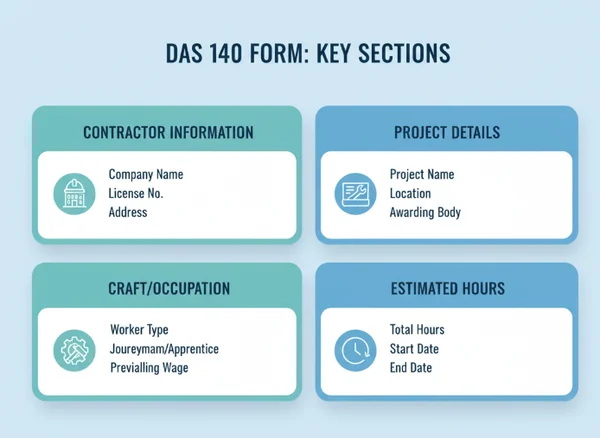
Key Information Required on the DAS 140
The form requests:
-
Contractor name, address, phone number, and license number
-
Awarding public agency name and address
-
Project name and job site location
-
Contract execution date and expected start date
-
Estimated journeyman and apprentice hours
-
Occupation or craft of the apprentice
-
Approximate dates apprentices will be needed
What Is the DAS 142 Form?
The DAS 142 form — officially the "Request for Dispatch of an Apprentice" — is your formal request to apprenticeship programs for apprentices when you need them on a job site.
Purpose of the DAS 142
Unlike the DAS 140, which is a notification, the DAS 142 is an action request. You use it to ask a local apprenticeship program to send you qualified apprentices for specific trades.
When Must You File It?
You must submit the DAS 142 at least 72 hours (three business days) before apprentices are needed on site. Best practice is to file it one full week in advance.
What Information Is Required?
The DAS 142 form requires:
- Contractor name and address
- Project location and start date
- Description of work to be performed
- Number of apprentices needed (you cannot enter "0" or "TBD")
- Craft or trade for which apprentices are requested
- Report date, time, and contact person on site
- Name and contact details of the apprenticeship committee
Apprenticeship Ratio Requirements
California generally requires a minimum 1:5 apprentice-to-journeyman hour ratio on public works projects. If you do not have enough registered apprentices already employed, the DAS 142 is how you request them.
What Is the Difference Between DAS 140 and DAS 142?
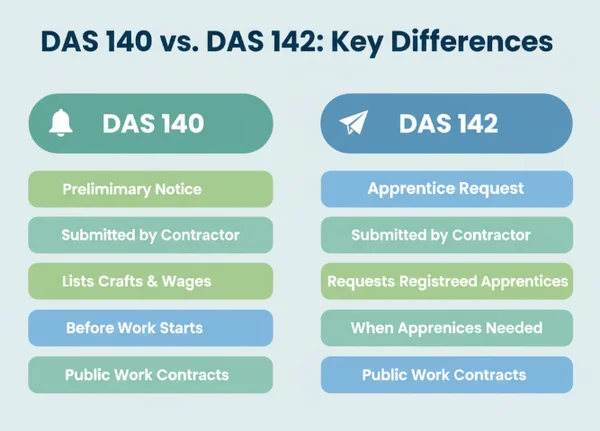
This is one of the most common questions contractors ask. Here is a clear comparison:
| Feature | DAS 140 | DAS 142 |
|---|---|---|
| Official Name | Public Works Contract Award Information | Request for Dispatch of an Apprentice |
| Purpose | Notify programs about a contract award | Request apprentices for a job site |
| When to File | Within 10 days of contract award | At least 72 hours before apprentices are needed |
| Who Receives It | Apprenticeship committees in your project area | The specific apprenticeship program you need |
| Required For | Every apprenticeable craft on the project | Each time you need additional apprentices |
| Type | Notification | Action request |
Think of it this way: the DAS 140 says "we have a project coming," and the DAS 142 says "please send us apprentices now."
How to Fill Out DAS Forms — Step-by-Step Guide
Filing DAS forms does not have to be complicated. Follow these steps to ensure compliance.
Step 1: Determine Which Forms You Need
As soon as a public works contract is awarded, identify every apprenticeable craft involved. You will need a DAS 140 for each one.
Step 2: Gather Your Project Information
Collect:
- Your contractor license number
- The awarding agency details
- Project name and site address
- Estimated start date and duration
- Projected journeyman and apprentice hours per craft
Step 3: Complete and Submit the DAS 140
Fill in all fields accurately. Send the form to the relevant apprenticeship committees within 10 days of the award. Keep copies for your records.
Step 4: Submit the DAS 142 Before Apprentices Are Needed
At least 72 hours before you need apprentices on site, complete and send the DAS 142 to the appropriate apprenticeship program. Specify the exact number of apprentices — do not leave this blank.
Step 5: Maintain Documentation
Keep copies of all submitted DAS forms, confirmation receipts, and correspondence with apprenticeship committees. This documentation is your proof of compliance during audits.
Common Mistakes When Filing DAS Forms and How to Avoid Them
Even experienced contractors make errors with DAS form submissions. Here are the most frequent issues:
- Missing the deadline. The DAS 140 must be filed within 10 days. The DAS 142 needs at least 72 hours lead time. Set calendar reminders as soon as a contract is awarded.
- Sending forms to the wrong recipient. The DAS 140 goes to all applicable apprenticeship committees — not to DAS itself. Double-check the programs in your project area.
- Leaving fields blank or using "TBD." Every field must be completed, especially the number of apprentices on the DAS 142. Incomplete forms may be considered invalid.
- Filing only for the prime contractor. Both prime contractors and subcontractors must file separately. A subcontractor cannot rely on the prime's filing.
- Forgetting to file for each craft. If your project involves electricians and plumbers, you need separate DAS 140 forms for each trade.
Avoiding these mistakes protects you from daily fines and keeps your project on schedule.
What Are the Penalties for Not Filing DAS Forms?
California takes apprenticeship compliance seriously. If you fail to file DAS forms correctly or on time, you may face:
- Daily penalties of up to $100 per day for each calendar day of noncompliance
- Back-payment obligations for apprentice wages not paid
- Debarment from future public works contracts in severe cases
- Project delays if apprenticeship requirements are flagged during compliance reviews
The cost of noncompliance far outweighs the effort of filing the forms on time.
Quick-Reference DAS Form Compliance Checklist
Use this checklist every time you are awarded a public works contract:
- Identify all apprenticeable crafts on the project
- Complete a DAS 140 for each craft within 10 days of the award
- Send each DAS 140 to the correct apprenticeship committees
- Submit DAS 142 forms at least 72 hours before apprentices are needed
- Specify the exact number of apprentices on the DAS 142
- Keep copies of all submissions and confirmations
- Track apprentice-to-journeyman ratios (minimum 1:5)
- Resubmit DAS 142 forms each time you need additional apprentices
What About the DAS 7 Form?
You may also encounter references to the DAS 7 form. This form is the "Apprentice Agreement" used when an individual is formally enrolled in an apprenticeship program. It is not a compliance filing for a specific project — instead, it documents the apprentice's registration, training plan, and program details.
For most contractors focused on project-level compliance, the DAS 140 and DAS 142 are the primary forms. However, if you also operate an apprenticeship program, the DAS 7 will be part of your administrative workflow.
Key Takeaways for DAS Form Compliance
Filing DAS forms correctly is one of the most important compliance steps for California public works contractors. Here is what to remember:
- The DAS 140 is a notification — file it within 10 days of the contract award for every apprenticeable craft.
- The DAS 142 is a request — submit it at least 72 hours before you need apprentices on site.
- Both prime contractors and subcontractors must file independently.
- Keep detailed records of every submission to protect yourself during audits.
- Penalties are real — daily fines and even debarment can result from noncompliance.
If you are preparing for a public works project and want to make sure your compliance paperwork is in order, start by reviewing your contract details and identifying every craft that requires apprenticeship filings. Taking action early is the simplest way to avoid costly surprises. For more compliance-related tools and resources, explore DAS form filing guides.
Frequently Asked Questions
What is a DAS form?
A DAS form is an official document required by California's Division of Apprenticeship Standards for contractors on public works projects. The two main forms are the DAS 140 (contract award notification) and DAS 142 (apprentice dispatch request), both ensuring apprenticeship compliance.
When do you need to submit a DAS 140 form?
You must submit the DAS 140 within 10 days of the contract award and no later than the first day apprenticeable craft work begins on site. Both prime contractors and subcontractors must file separately for each trade.
What is the difference between DAS 140 and DAS 142?
The DAS 140 notifies apprenticeship committees that a public works contract has been awarded. The DAS 142 formally requests that apprentices be dispatched to your job site. One is a notification, the other is an action request.
Who needs to file DAS forms in California?
All contractors and subcontractors working on California public works projects valued at $30,000 or more must file DAS forms for each apprenticeable craft involved.
What happens if you do not file DAS forms?
Failure to file can result in daily fines of up to $100 per day, back-payment obligations, and potential debarment from future public works contracts. Keeping compliance records is essential.
How do I fill out a DAS 142 form correctly?
Include your contractor information, project details, the number of apprentices needed (never "0" or "TBD"), the craft or trade, report date and time, and the contact person on site. Submit it at least 72 hours before apprentices are needed.
What is the apprenticeship ratio for public works in California?
California generally requires a minimum 1:5 ratio of apprentice hours to journeyman hours on public works projects. The DAS 142 form helps you request apprentices to meet this ratio.
What is a DAS 7 form?
The DAS 7 is an Apprentice Agreement form used to formally register and document an individual's enrollment in an apprenticeship program. It covers training plans and program details, rather than project-level compliance.